|
Growing up in Shanghai at a time of severe air pollution in China, Yongcheng (Suyue) Cao realized early on that environmental problems present a daunting challenge. Now, as a civil and environmental engineering Ph.D. student at UMD, she is honing in on one of these problems—the persistence of per- and polyfluoroalkyl substances (PFAS), often dubbed “forever chemicals.”
Working with her advisor, Professor Birthe Kjellerup, Cao has been experimenting with microbial organisms that can break down these stubbornly resistant compounds. The process is complex, because PFAs in effect protect themselves by releasing fluoride that is toxic to the microbials.

When not hard at work in the lab, Cao pursues high-endurance sports such as marathon running and rock climbing.
For that reason, “we’re focusing on which bacteria can best degrade the PFAs and not be inhibited by the high fluoride concentration,” Cao explains.
Her work related to PFAs represents both a continuation of and a change from her master’s degree research at UMD, which focused on how land development and different kinds of land use can affect the concentration of Polychlorinated biphenyls (PCBs) in soil and sediment. Though PCBs remain widespread, they have also been studied extensively since their emergence in the 1970s.
By contrast, PFAS are a relatively new phenomenon and much about them remains unknown. And that’s a concern, since these long-lasting chemicals are found in non-stick cookware, cosmetics, food packaging, rain-resistant garments, and many other consumer products.
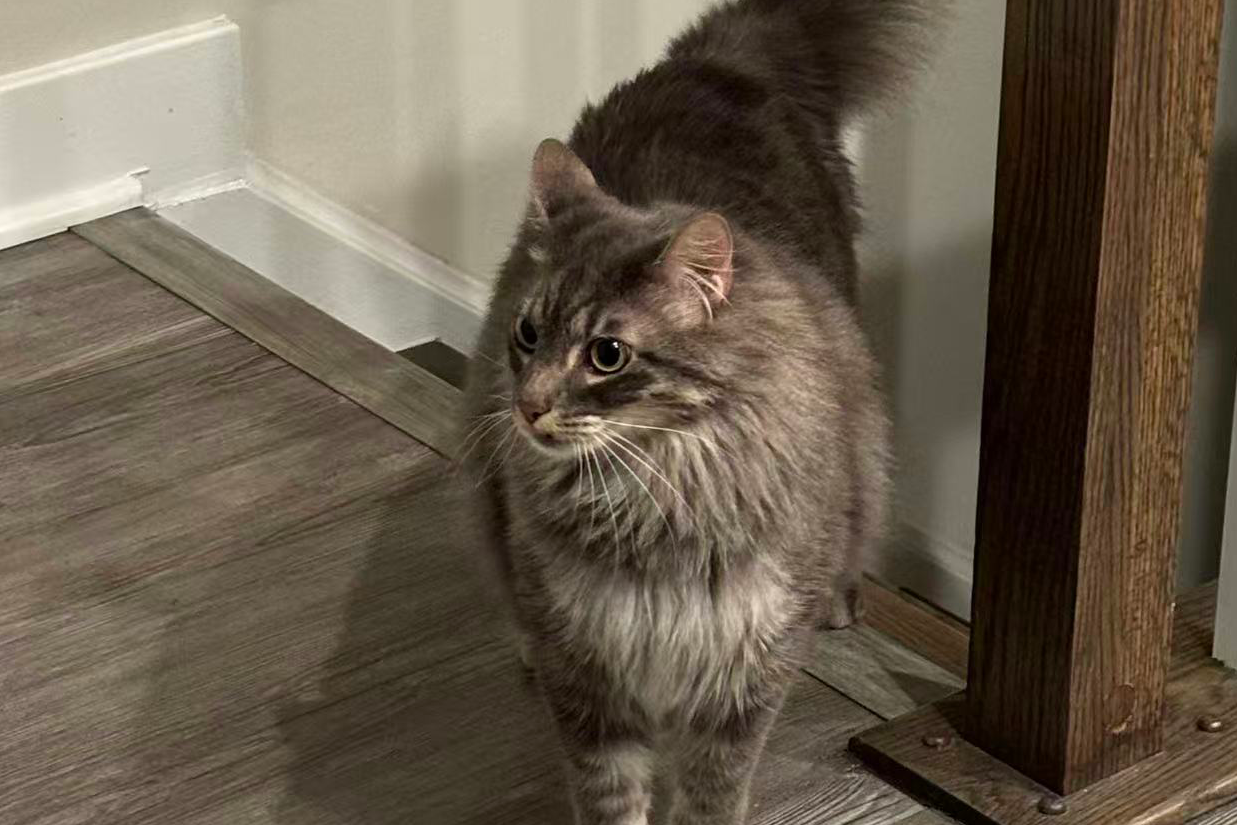
Cao’s cat, named Leggy, is an honorary member of the research group.
Cao, who likes the problem-solving aspect of environmental engineering, hopes her work will help mitigate the risks to consumers and to the planet. “I want to help find feasible solutions,” she said.
Cao Selected for Microbiome Center Fellowship
While making progress in the lab, Cao has also leveraged a prestigious opportunity to build presentation and teamwork skills while networking with researchers from different fields. She was selected as a 2026 Microbiome Center Fellow, joining a cohort of eight graduate students from across UMD.
Through workshops and other activities, the Fellows have received training in team science and cross-disciplinary system approaches that are essential to advancing innovation through microbiome research. The program is run by the Center for Excellence in Microbiome Sciences, with support from the UMD Grand Challenge 1.0 initiative.
“It’s valuable to interact with researchers who have a variety of interests and working styles,” Cao said. “We can learn from each other.”
A Researcher’s Patience, a Marathon Runner’s Endurance
Professor Kjellerup, Cao’s advisor, noted that research on “forever chemicals” requires both ingenuity and patience.
“Suyue's curious mindset, persistence and humor are some of the characteristics that I appreciate and they are also important for working with persistent contaminants, where experiments can take many months, late days in the lab and lots of hard work,” she said.
“These characteristics are also being put to use in her extracurricular interests such as running marathons (day and night competitions) and rock climbing. Leggy, a domestic medium-haired cat, is also an honorary and much appreciated group member,” Kjellerup said.
October 14, 2026
|



