 |

|
|
Yifan Chen (left) tries out an airplane design with WETCC camp participant Mia Rechichi. |
|
Located near the Wild Rice River in Mahnomen, Minnesota, White Earth Tribal and Community College (WETCC) is at the center of local efforts to revitalize Ojibwe tribal culture while boosting educational and career opportunities on the state’s largest Native American reservation.
University of Maryland (UMD) faculty and graduate students contributed to that mission this summer during elementary and middle-school STEM transportation camps held by WETCC in collaboration with UMD and North Dakota State University (NDSU). Faculty from all three institutions are part of the Center for Multimodal Mobility, a UMD-based Urban Transportation Center led by Professor Cinzia Cirillo, which sponsored the program.
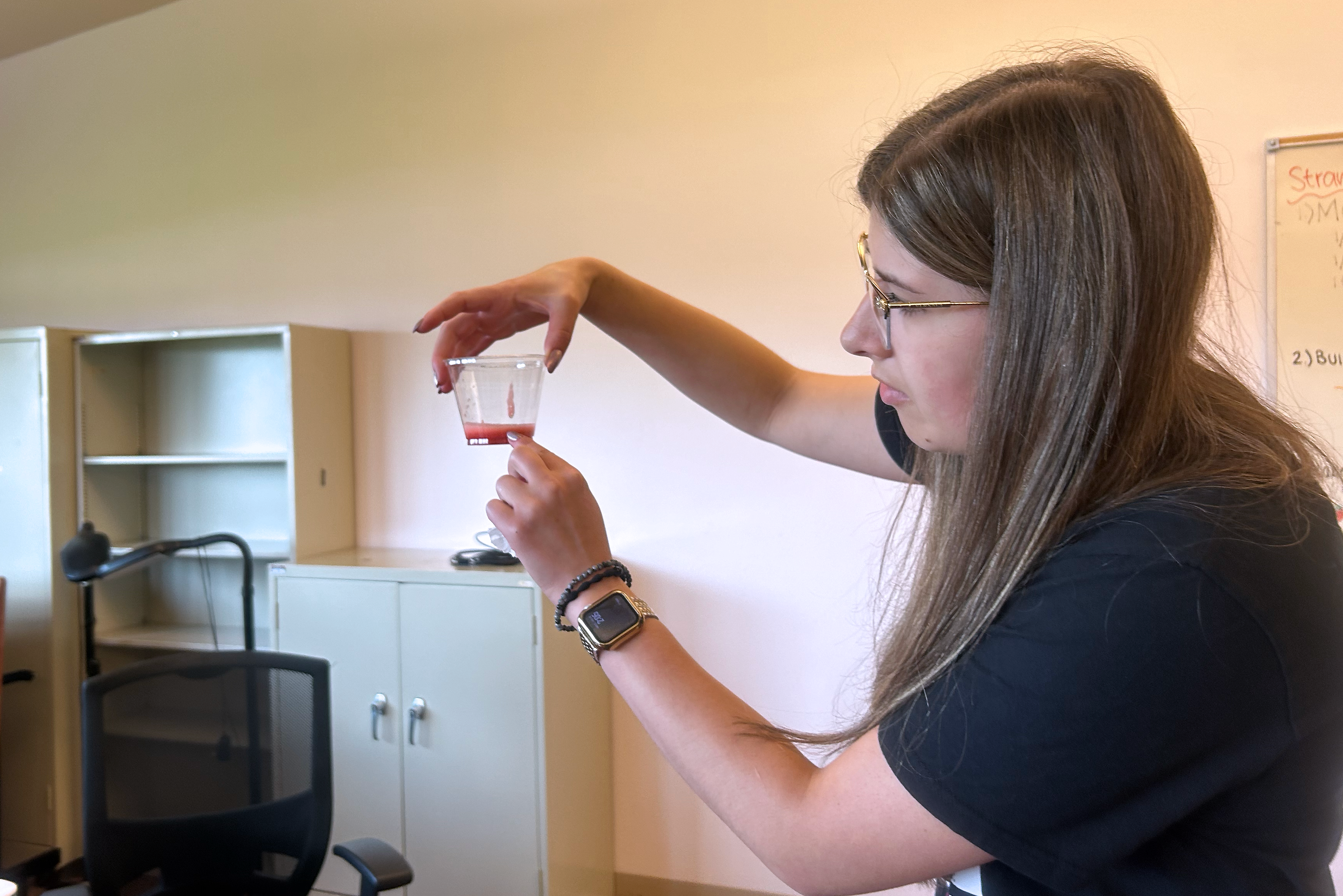
Campers experimented with strawberry DNA extraction in an activity led by UMD environmental engineering doctoral student Lillyanna House (pictured).
“The goal is to get kids interested in the sciences, and in how transportation relates to specific needs in the area, including industries that are really important on the reservation,” said WETCC librarian and academic coach Nora Schulz. “We also want to pique their interest in higher education, plant the seed of ‘I can do this.’”
Transportation is a topic of vital concern on the White Earth reservation, which spans 1,296 miles, much of it farmland. Beet farming is a mainstay of the local economy, and the crop must often travel long distances between farm and store. People also need to get around—not always a simple proposition in a region where many lack cars or trucks. The county bus system, which links all the reservation’s villages and towns, not only provides mobility access but employs many locals.
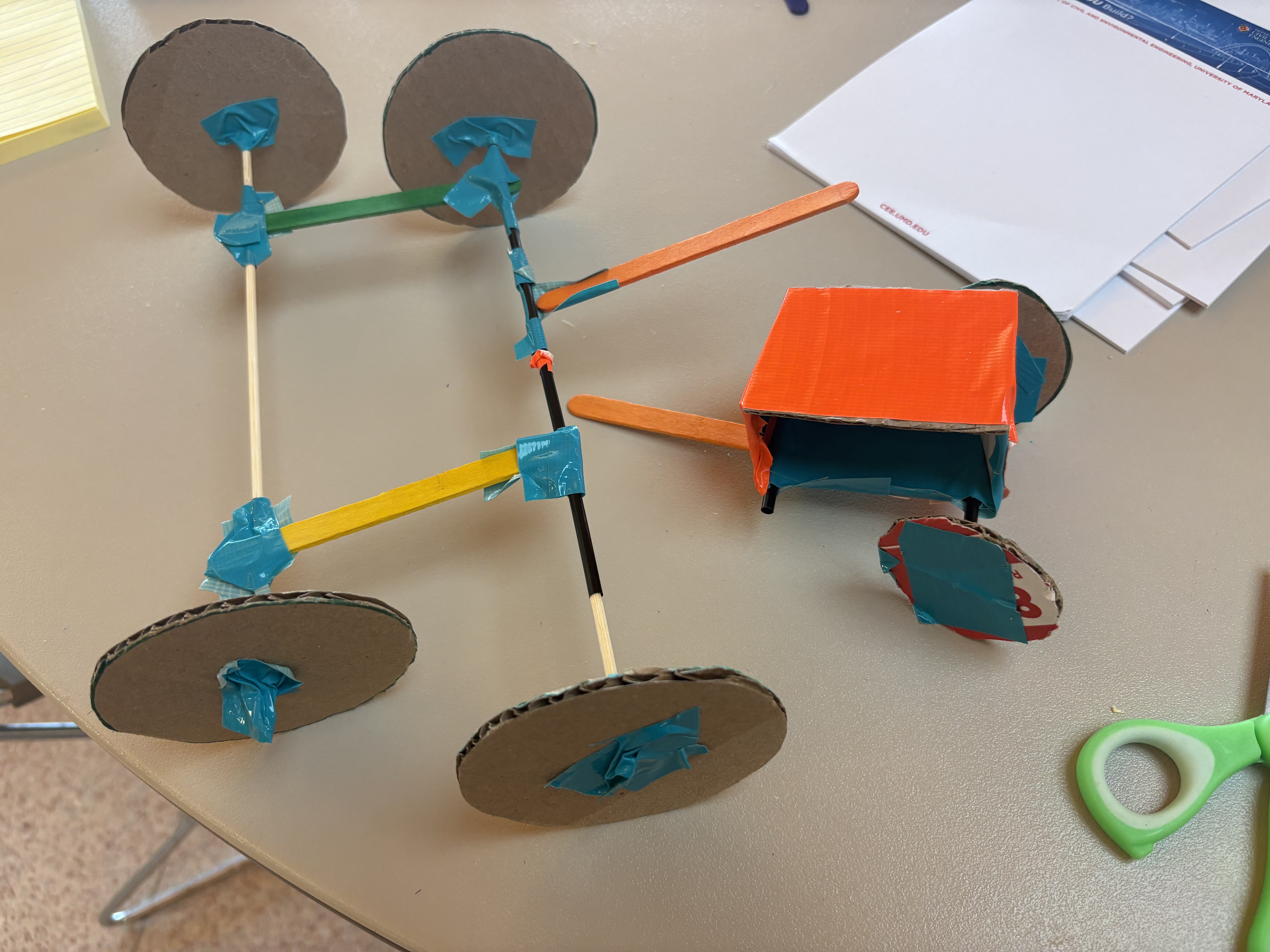
Maryam Khan, a doctoral student in transportation engineering, explained mechanics fundamentals such as momentum, friction, and traction, and helped campers construct vehicles out of materials such as cardboard, popsicle sticks. And wooden skewers.
Teaching Engineering Concepts Through Hands-on Fun
During the WETCC camps, UMD doctoral students Yifan Chen, Lillyanna House, Maryam Khan, and Raas Sarker Tomal, in collaboration with UMD Professor Birthe Kjellerup, engaged the youthful participants with activities that taught science and engineering concepts in a fun way, while also highlighting the transportation angle.
Chen, whose doctoral work focuses on mobility analysis, walked participants through aviation fundamentals, including lift, drag, thrust, weight, and Bernoulli’s principle, and helped them experiment with different paper plane designs, which were then tested in an informal contest outside the college. To ramp up difficulty, campers added paper clips as “cargo.”
House, who conducts research on the remediation of polyfluoroalkyl substances, showed middle-schoolers how to extract DNA from strawberries with a simple technique using household ingredients such as dish soap and salt. The farming industry, she noted, is interested in being able to engineer strawberries that can stay fresh for longer periods, allowing them to be transported to markets across the globe.
A similar DNA extraction activity was led by Sophie Shirtliff, a student at Maryland’s Mt. Hebron High School, for elementary schoolers, while fellow Mt. Hebron student Miles Shirtliff facilitated a game—devised by UMD civil and environmental engineering faculty specialist Patricia Arcellano—about pumpkin harvesting and transportation.
Doctoral students Khan and Tomal, both of whom study travel behavior, also worked with elementary school campers. In Khan’s activity, participants used elastic bands, straws, popsicle sticks, wooden skewers, and other materials to build vehicles that were then tested on a homemade ramp. Tomal, meanwhile, introduced students to the algorithm used by apps such as Google Maps, engaging them with a puzzle-like game.
Chen and House’s advisors at UMD are, respectively, Associate Professor Xianfeng (Terry) Yang, who directs the Maryland Transportation Institute, and Assistant Professor Guangbin Li, Principal Investigator at the Nutrient Energy Smart (N.E.S.) laboratory. Khan and Tomal are advised by CMMM’s director, Professor Cirillo.
Fostering Students’ Interest in Higher Education
WETCC’s Schulz said she hopes campers came away with an expanded perspective. “Seeing people who are graduate students, and learning how they got where they are, helps open up possibilities,” she said. “It gets the kids thinking about avenues they could pursue in their own education and careers.”
To nudge those possibilities further, the camp organizers also baked in day trips to NDSU, with participants touring the campus and learning about the university experience.
Founded in 1997 by the White Earth Tribal Council, WETCC offers degree programs in areas ranging from business education to environmental science, human services, and Native American Studies.
It also provides classes in the Ojibwe language, which remains endangered in the aftermath of 19th and 20th-century policies of forced assimilation, including boarding schools and bans on traditional ceremony.
Beverly St. John, a tribal elder who has been involved with WETCC since its founding, said the community is navigating between its traditions and the legacy of colonialism. “Our goal is a healthy Ojibwe culture alongside a healthy colonial way of being,” she said. “There’s an understanding that the college should foster a third culture, which is about mixture, allowance, and tolerance for each other.”
August 5, 2026
|


