
|
 |
Environmental engineering summer internship students weigh out chemicals for their solutions. |
|
For high school students looking for solid career prospects, civil and environmental engineering has much to offer. But many are not familiar with the field.
To help change that, UMD’s CEE department runs summer internship programs intended to galvanize enthusiasm through hands-on projects, presentations, and tours.
Two programs took place concurrently during the summer of 2026. Patricia Arcellana, faculty specialist at the department, led a program focused on environmental engineering. A second program was run by Tom Jacobs, head of the Center for Advanced Transportation Technology (CATT), which leverages hi-tech solutions to address congestion and other transportation challenges. The department is a Montgomery County Public Schools Summer RISE Host and drew CATT interns through this program.
Together, the combined internship opportunities drew enthusiastic students from several local schools. They came away having successfully completed projects similar to those undertaken by college students majoring in CEE.
Learning Sampling and Analysis Techniques
Interns in Arcellana’s program got a crash course on environmental engineering methods, including how to use Inductively Coupled Plasma Optical Emission Spectrometry (ICP-OES) and conduct an experiment with controls.
They then embarked on a variety of sampling and analysis projects. Oxon Hill senior Angela Chea, for instance, set out to analyze samples from water fountains on the UMD campus.
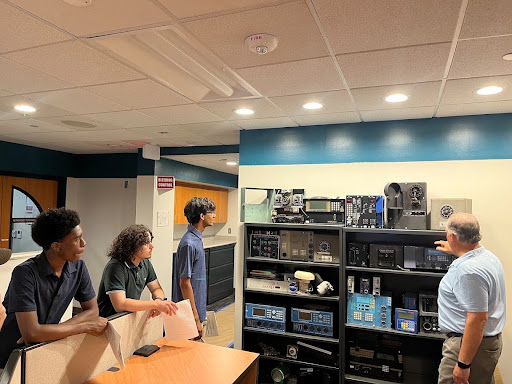
RISE students learn about the advances in traffic signal control technology used in Montgomery County, Maryland.
Arcellana says her primary goal was to introduce students to a field that sometimes slips off the radar, despite offering significant career potential.
“There are a lot of job opportunities in civil and environmental engineering, especially in Maryland, since this is such an aquatic state,” she said. “There are lots of places you can go with an environmental engineering degree, and there are also opportunities here if you want to stay in the Delmarva region.”
Transportation Engineering: A Field With Everyday Impact
Jacobs, the CATT director, expressed similar views about transportation engineering and operations, saying he hoped his center’s internship program would inspire students to consider it as a career choice.
Participants learned to use data analysis tools for performance-based decision making and then worked on a roadway safety project. They also visited the Maryland statewide operations center and the Montgomery County Advanced Transportation Management Center.
And they didn’t just learn, Jacobs said. They participated. While riding along with a safety service patrol, an alert came in about a car stranded on the Beltway.
The patrol—with the students still tagging along—drove to the scene and pushed the stuck vehicle out of the way.
The experience was fun, and it also highlighted the everyday relevance of the transportation field, particularly the importance of traffic incident management in helping reduce non-recurring congestion.
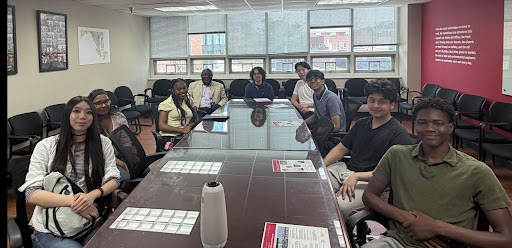
CEE summer interns are pictured with the department chair, Professor Nii Attoh-Okine.
“We all depend on transportation systems,” Jacobs said. “In this profession, you get to see the things you work on have an impact on the world.”
“That’s true for CEE in general. It’s work that makes a difference in people’s lives,” he said.
Students Gain Experience With State-of-the-Art Tools
Ved Bhise, a student at Richard Montgomery High School and CATT summer intern, said that he and other interns had the opportunity to use the nation’s largest transportation database, known as the Regional Integrated Transportation Information System (RITIS).
With the help of RITIS and the support of CATT mentors, Bhise said, he was able to create a comprehensive roadway safety audit. “I chose an intersection in my neighborhood that I noticed had design flaws, and used the tools at my disposal to propose and justify solutions in a formal presentation,” he said.
CATT’s tools allow for an interdisciplinary view of travel behavior and roadway safety, Bhise noted. “I was able to apply multiple distinct fields: behavioral psychology when considering how humans interact with different intersection designs, physics when calculating kinetic energy (aka crash severity) at different speeds, public policy when considering local responses to past changes, and data analysis via RITIS to statistically justify changes.”
Through the internship, Bhise said, he gained a fuller picture of the transportation field, from the on-the-ground work being done by service patrols on highways to long-term infrastructure projects.
“It was deeply inspiring to see so many passionate people at every level working to make our roads both safer and more efficient,” he said.
To learn more about summer internship programs at the UMD Department of Civil and Environmental Engineering, contact Donna Okil-Lee, recruitment and retention coordinator, at dlee1973@umd.edu.
September 10, 2026
|


